
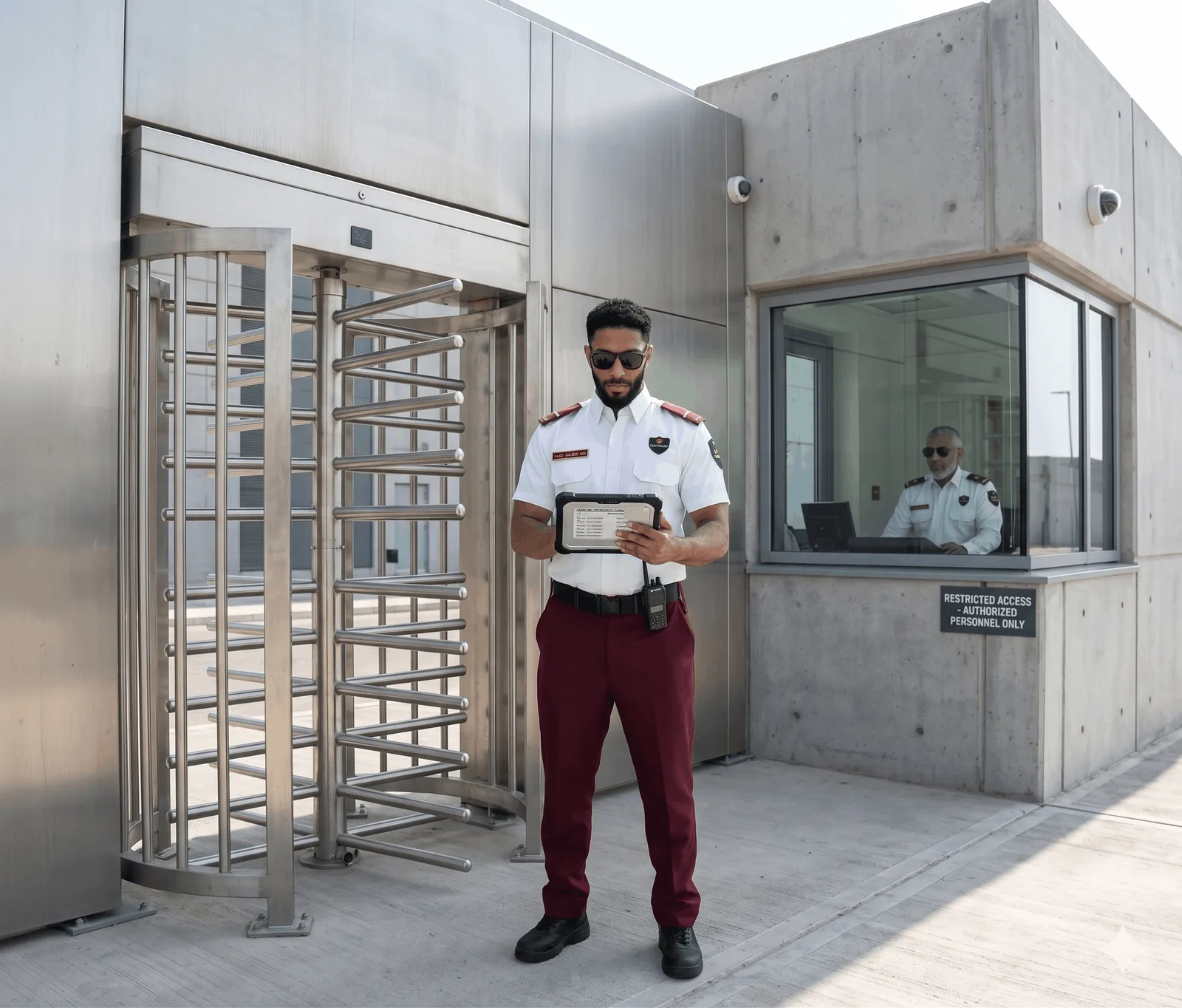
Boredom is the operational threat
A fixed post is a guard assigned to one location with one function — a barrier, a checkpoint, a critical door, a plant room. It is the simplest deployment in security, and its failure mode is entirely predictable: the post degrades.
Vigilance decay is not a discipline problem
It is a well-documented feature of sustained monitoring. Attention to a low-event, repetitive task falls off sharply after roughly twenty to thirty minutes. This is human, not a defect in your guard, and no amount of instruction fixes it.
A guard at a quiet post for eight hours is not watching for eight hours. Any provider who tells you otherwise is either misinformed or hoping you are.
What actually counters it
- Rotation between posts across a shift, where the site has more than one.
- An active task — logging, checks, verification — rather than passive observation. A guard with something to do stays alert; a guard with nothing to do does not.
- Unannounced supervisor visits. The single most effective control, and the first thing cheap providers cut.
- Honest post design. If a post genuinely has nothing happening, the right answer may be a patrol, not a chair.
When a fixed post is genuinely correct
When the location itself is the asset and continuous presence is the deterrent: a single controlled entry, a critical utility room, a cash-handling area, a high-value store. The value is that someone is always there — and the moment that stops being true, so does the value.
The question to ask your provider
"How often does a supervisor physically visit this post, unannounced, and can I see the visit log?"
The answer tells you whether you are buying a guarded post or an occupied chair.