
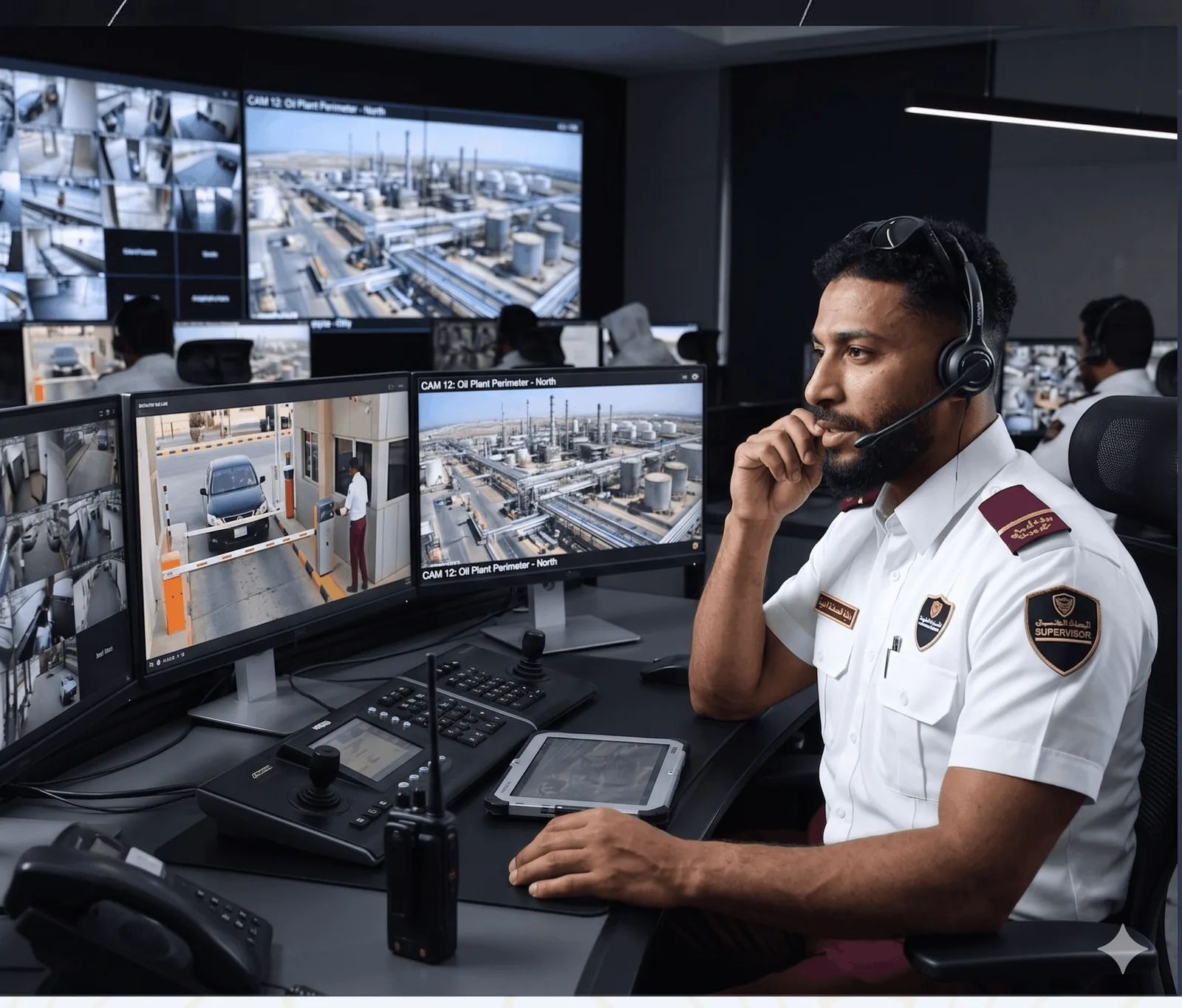
Security Guard Quality Control in Saudi Arabia — Measuring and Maintaining Service Standards
Security guard quality is notoriously difficult for clients to measure. Without independent verification, you are relying on the security company to self-report its own performance — a structural conflict of interest. Effective quality control for security services requires independent measurement, documented standards, and transparent reporting that gives clients genuine visibility of what is happening on their sites.
Arab Security Guard Services operates a formal quality control framework for all client contracts. We measure guard performance against defined KPIs, conduct independent inspections, review incident documentation for accuracy and completeness, and provide clients with monthly quality reports that give genuine visibility of service delivery.
Quality Control Framework
- Defined service standards — every contract specifies measurable standards: patrol frequency, response times, documentation completeness, uniform compliance
- Independent supervisor inspection — supervisors assess guard performance against standards on each visit, using a standardised assessment form
- Documentation audit — monthly review of duty logs, incident reports, and access control records for accuracy and completeness
- Client feedback process — formal mechanism for clients to raise performance concerns, with a defined response and resolution timeline
- Monthly QC report — written report covering KPI performance, supervisor visit findings, incidents, and any corrective actions taken
- Continuous improvement programme — underperformance trends drive training, redeployment, or procedure changes
KPIs and Metrics: How We Measure Security Quality
Quality control without measurable KPIs is subjective and unenforceable. Arab Security Guard Services operates a defined KPI framework for all security contracts. Clients receive monthly KPI summary reports and have access to real-time incident data through their contract account manager.
| KPI | Target Standard | Reporting Frequency |
|---|---|---|
| Guard Absenteeism Rate | <3% per contract month | Monthly |
| Same-Shift Cover Provision | 100% of absences covered within 4 hours | Per incident |
| Access Log Completion Rate | 100% per shift | Weekly audit |
| Inspection Audit Pass Rate | >95% per site per month | Monthly |
| Incident Response Time | Supervisor on-site within 30 minutes (critical) | Per incident |
| Uniform Compliance Rate | 100% per shift inspection | Per supervisor visit |
KPI failures trigger an automated corrective action workflow. Persistent KPI failures are grounds for contract review and, where appropriate, service credits as defined in the contract terms.
Key Performance Indicators We Measure
Every client contract specifies measurable KPI thresholds, not aspirational targets. The KPIs tracked across all contracts are:
- Patrol completion rate — target ≥95% of scheduled patrols completed and logged per week. Measured via GPS or physical log-point check-ins at defined waypoints
- Incident documentation accuracy — target 100% of incidents logged within 2 hours of occurrence, with the mandatory fields (time, location, nature, action taken, escalation) complete
- Supervisor visit frequency — measured against contracted cadence; any week where the contracted visit frequency is not met is flagged in the monthly report with a root cause explanation
- Post fill rate — target 100% of contracted shifts covered with a licensed officer; unfilled shifts and late reliefs are reported immediately to the client and tracked monthly
- Uniform and equipment compliance — assessed on every supervisor visit; non-compliance is logged and triggers an immediate corrective action
- Client satisfaction score — formal score collected quarterly via structured review; any score below threshold triggers a service review meeting
Inspection Frequency
Quality control inspections operate on two tracks. Supervisory inspections occur at the contracted cadence (minimum twice weekly, daily for elevated-risk sites) and assess the full checklist of guard conduct, documentation, and patrol compliance. Management QC audits are conducted monthly by a senior operations manager — independent of the site supervisor — who reviews all underlying data, spot-checks duty logs, and interviews the assigned supervisor to identify any systemic issues the day-to-day reporting may be obscuring. Clients receive the outcome of both tracks in their monthly report.
What Happens When a Guard Fails an Inspection
Inspection failures are categorised by severity. Minor deficiencies (uniform item missing, single late log entry) trigger an immediate verbal correction on-site, documented in the visit report, with a follow-up check within 48 hours. Moderate failures (patrol route not completed, duty log gaps, equipment malfunction not reported) trigger a written warning to the guard and mandatory refresher briefing within 72 hours; the client is notified in the next report cycle. Serious failures (sleeping on duty, abandoning post, falsified logs, conduct violations) trigger immediate removal of the officer from the site, the same day if possible, with the client contacted directly. A replacement officer is sourced as a priority and a full incident report provided. The client has the right to request permanent replacement of any officer at any time — no justification required.
📋 Service Note
Included in all contracts — ask about our full qc programme. Contact us on WhatsApp to discuss your requirements.