NEOM, the Red Sea Project, Qiddiya, and Diriyah Gate have security requirements that go well beyond standard construction site guarding — combining HCIS compliance, VIP protection, remote site logistics, and hospitality-sensitive access management.
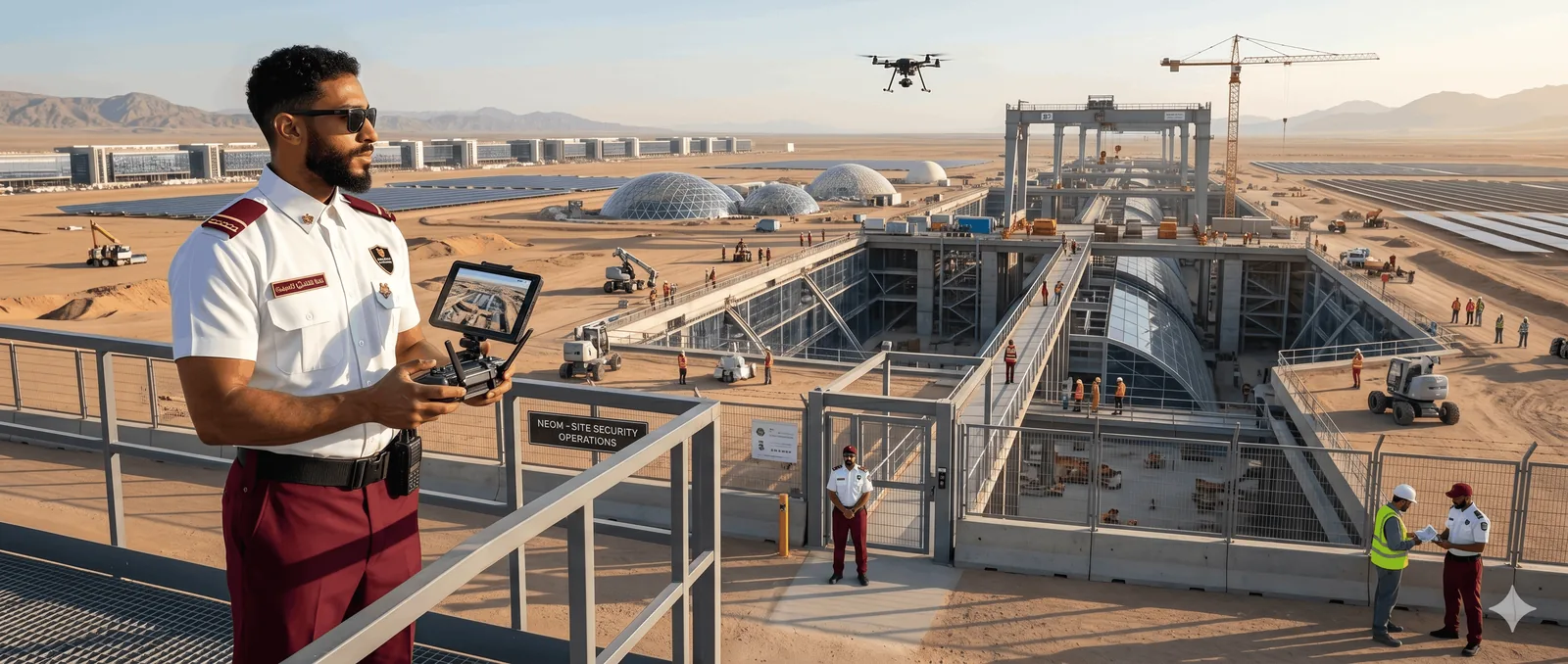
🏗️ Vision 2030 Projects: Security Staffing at a Glance
Saudi Arabia's Vision 2030 giga-projects are not ordinary construction sites. They combine the physical security requirements of large industrial construction with the access control requirements of internationally sensitive projects (due to the volume of foreign contractors, VIP visitors, and media attention) and the operational complexity of sites that are simultaneously under construction and beginning to operate.
NEOM, for example, spans 26,500 square kilometres of the Tabuk region — making it one of the largest construction security deployments in history. The Red Sea Project combines coastal construction, hospitality operations, and environmental sensitivity zones. Diriyah Gate is simultaneously a construction project and a UNESCO World Heritage Site with active visitor operations. Each creates unique security staffing requirements that generic construction security companies are not equipped to handle.
Security staffing for NEOM and its component projects — The Line, Sindalah Island, OXAGON, and Trojena — operates across several distinct layers. At the construction layer, HCIS-compliant guards are required for all utility and infrastructure elements. At the project operations layer (where hotel pre-openings and hospitality operations are beginning), commercial-grade security with hospitality sensitivity is required. At the VIP and executive visit layer — which is near-constant given NEOM's profile — close protection officers and executive escort services are required.
Mobilisation to NEOM sites requires accommodation planning. Guards assigned to NEOM sites cannot commute daily from Tabuk city for remote construction zones — accommodation within or adjacent to the site must be arranged by the security provider. Arab Security Guard Services factors accommodation costs and logistics into all NEOM deployment proposals. See our dedicated NEOM security page for full service details.
The Red Sea Project — a luxury tourism destination spanning more than 50 islands in the Red Sea — presents unique security logistics. Island construction sites require marine-adjacent guard deployment, boat access management, and construction site security that accounts for coastal environmental protocols. As the project transitions from construction to hospitality operations, security needs shift toward guest-facing roles with a luxury hospitality sensibility.
The Red Sea Project Authority has specific security vendor approval requirements — not all MOI-licensed companies are cleared to operate on project sites. Arab Security Guard Services is familiar with these requirements and can advise on the approval process for your specific site and contract scope.
Qiddiya (entertainment city near Riyadh), Diriyah Gate (heritage development in Ad Diriyah), and King Salman Park (the world's largest urban park) share a common security challenge: they are simultaneously active construction sites and destinations that receive VIP, media, and public visits during construction phases. Security at these sites must balance the physical security of a live construction environment with the access management and presentation standards of a world-class attraction.
This dual requirement — hard-hat-zone construction security and guest-facing access management — requires a security provider with experience in both domains. Guards operating at heritage sites like Diriyah Gate must also be briefed on the site's cultural significance and the additional access restrictions around active archaeological zones.
Sub-contractors working on Vision 2030 giga-projects face a specific procurement challenge: they are often required by the project authority or main contractor to use pre-approved security providers. If your organisation has not yet confirmed security vendor approval requirements for your giga-project scope, this should be addressed before your security contract is tendered.
For contractors not yet locked into a specific vendor, the two most common giga-project security staffing structures are: (1) a manpower supply contract, where the security provider supplies certified guards and the contractor manages day-to-day deployment, and (2) a managed service contract, where the security provider takes responsibility for post coverage, supervision, and compliance documentation. For most project environments, the managed service model reduces the administrative burden on the contractor's own project management team.
Need Security Guards for a Vision 2030 Project?
We have experience across NEOM, Red Sea Project, and major giga-project sites. Contact us for a site-specific proposal.
WhatsApp for a QuoteResponse within 2 hours · No obligation · Nationwide KSA
Tell us about your site and we will come back with a realistic scope — including telling you if you need less than you think.