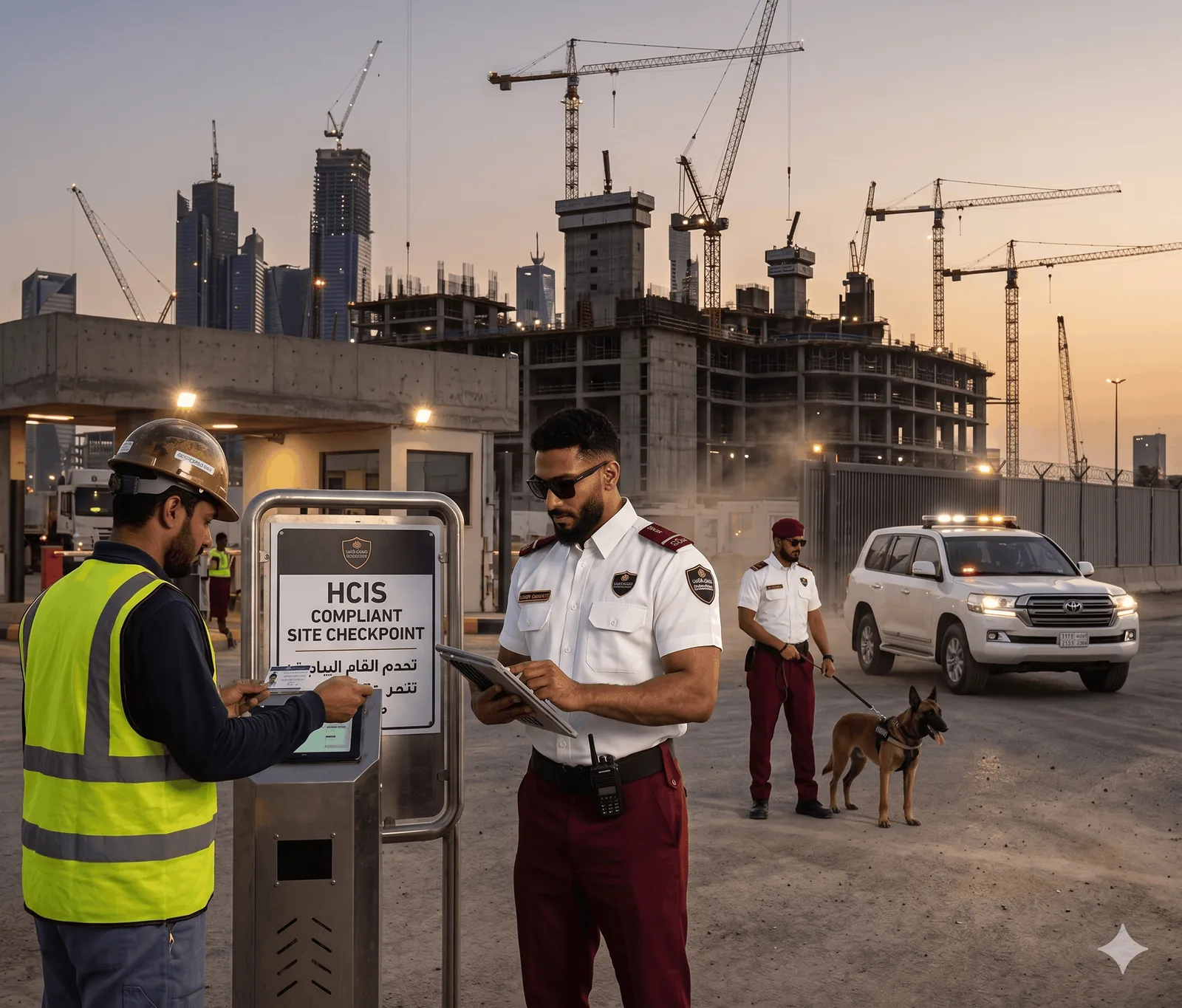
Construction and infrastructure projects in Saudi Arabia — particularly in the industrial zones of Jubail, Yanbu, Ras Al-Khair, and increasingly in the giga-project corridors — fall under HCIS (High Commission for Industrial Security) regulation. HCIS compliance is not a formality: failures can trigger site shutdown orders. This guide walks through what auditors check and how to ensure your site passes.
Which Construction Sites Are HCIS Regulated?
HCIS regulation applies to construction projects that:
- Are located within designated industrial zones (Jubail, Yanbu, Ras Al-Khair, and others)
- Involve construction or maintenance of industrial infrastructure — pipelines, power plants, refineries, utilities
- Are contracted to or for companies operating under HCIS oversight (petrochemical companies, utilities, etc.)
- Have been specifically designated as HCIS-regulated by the Ministry of Interior
If you are working on a project for Saudi Aramco, SABIC, SEC, or a similar entity, assume HCIS compliance is required until confirmed otherwise. Giga-project sites including NEOM are increasingly adopting HCIS-equivalent security standards even outside formal HCIS zones.
What HCIS Auditors Check: The Full List
1. Security Company Registration
The first thing an HCIS auditor checks is whether your security provider holds valid HCIS registration. This is separate from the MOI operating licence. A company can be MOI licensed but not HCIS registered — and that makes them non-compliant for industrial sites.
Action: Request a copy of your security provider's HCIS registration certificate before they deploy a single guard. See our HCIS Compliance Security services for what full documentation looks like.
2. Individual Guard Credentials
Every guard on an HCIS-regulated site must hold both MOI licensing and HCIS-approved industrial security certification. Auditors will physically check guard credentials on-site. A single guard without valid credentials can trigger a non-compliance finding.
Action: Maintain a guard credentials log on site with copies of every deployed guard's MOI licence and HCIS certification.
3. Post Orders and Security Plan
HCIS requires a documented security plan for every regulated site, including:
- Site map with security post locations
- Specific post orders for each guard position
- Emergency response procedures (fire, explosion, medical emergency, intruder)
- Escalation chain — from guard to supervisor to facility management to HCIS if required
- Communication procedures
4. Access Control Records
HCIS sites require a formal access control system. This means: a staffed gatehouse with trained access control guards, a visitor register or biometric system, vehicle access logs, and procedures for contractors and deliveries. Paper visitor books may not meet HCIS standards on higher-risk sites — digital access control systems are increasingly expected.
5. Equipment Standards
Guards on HCIS sites must be equipped to the standard specified in the security plan. At minimum: uniform, communications device (radio or phone with logged number), torch, and the documentation kit. High-risk sites may require additional PPE, vehicle access barriers, and CCTV monitoring.
6. Incident Reporting Log
All security incidents — even minor ones — must be logged in a formal incident reporting system. Auditors check the incident log for completeness, timeliness, and whether incidents were appropriately escalated. Gaps in the log raise immediate concerns.
Common HCIS Audit Failures
⚠️ Most Frequently Cited HCIS Deficiencies
- Security provider not HCIS registered (most common critical finding)
- Individual guards lacking HCIS certification (second most common)
- Missing or outdated security plan / post orders
- Access control records incomplete or not maintained
- Supervisor inspection logs absent or irregular
- Emergency response procedures not rehearsed or documented
Emergency Pre-Audit Remediation
If you have an upcoming HCIS audit and have just identified compliance gaps, the fastest resolution is to engage an HCIS-registered security provider immediately. Arab Security Guard Services can deploy HCIS-compliant guards within 24–48 hours and provide the full documentation package (security plan template, post orders, guard credentials log) in parallel. See our emergency security deployment service for urgent requirements.