Two separate regulators govern security in Saudi Arabia. MOI covers all private security operations. HCIS covers industrial and energy sites. Knowing which applies to your site — and whether your security provider holds both — is essential before you sign a contract.
🏛️ Quick Reference: MOI vs HCIS
The MOI licence is the foundational legal requirement for all private security operations in Saudi Arabia. No security company can legally deploy guards at any commercial, residential, or government site without a current MOI licence. The licence is issued by the Public Security directorate under the Ministry of Interior and must be renewed annually.
The MOI licence covers: the company's legal right to operate as a private security provider, the company's obligation to comply with Saudization (Nitaqat) requirements, individual guard registration and identity verification, and uniform and equipment standards. Any client engaging a security provider should request a copy of the current MOI licence as a baseline due diligence step — and verify it is not expired.
Individual guards also carry a personal MOI security guard card, which includes their identity, licence number, and employer registration. This is what guards must present at any site where client-side security requirements mandate documentation checks. It is also what HCIS auditors ask to see at regulated sites.
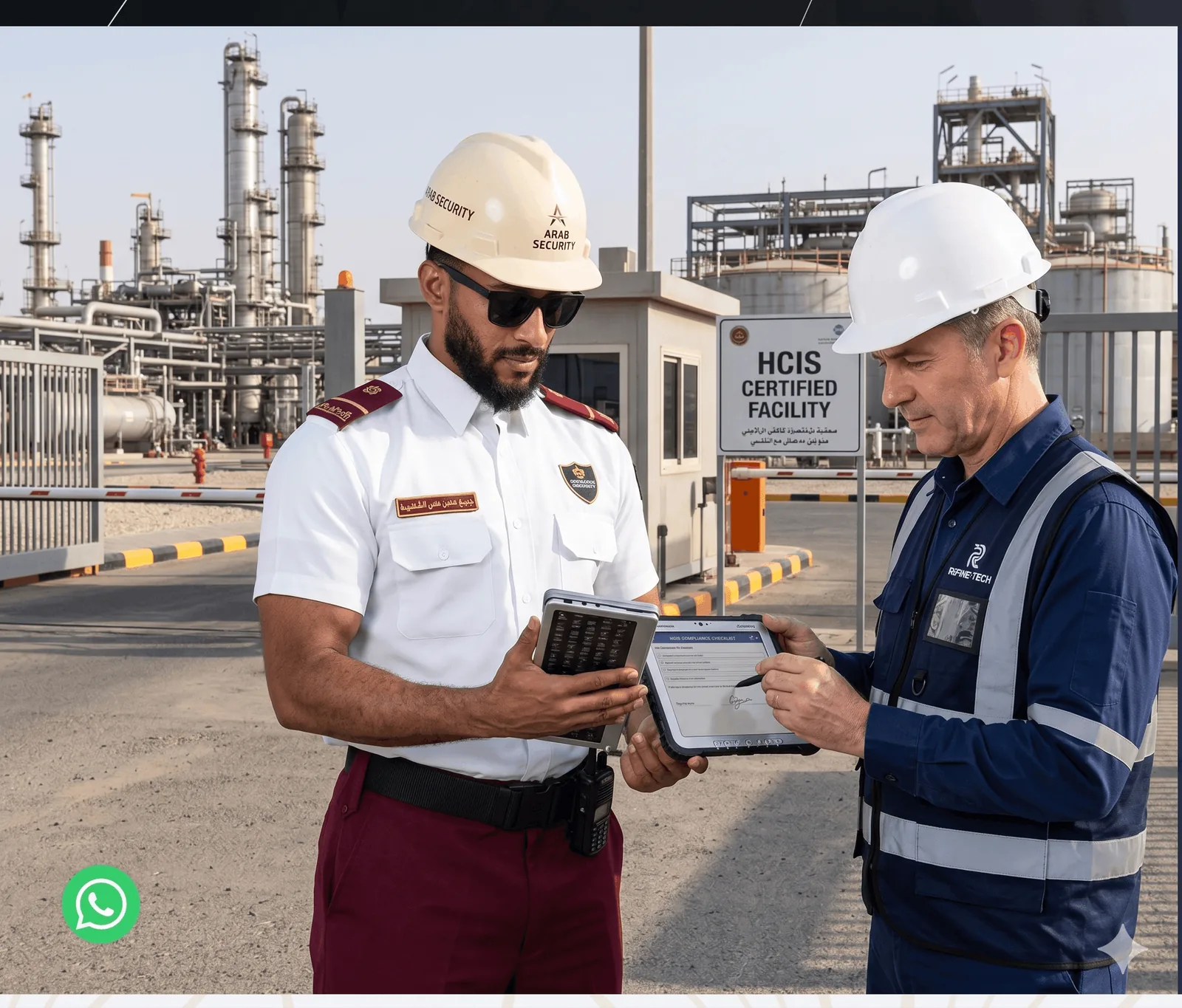
The Higher Commission for Industrial Security — known as HCIS — is a separate regulatory body that governs security at industrial, energy, and infrastructure sites in Saudi Arabia. HCIS was established to address the specific security requirements of Saudi Arabia's vast oil and gas, petrochemical, desalination, and power generation infrastructure.
HCIS approval is mandatory for security companies providing services at: oil and gas facilities (upstream, midstream, downstream), petrochemical plants and refineries, power generation and distribution infrastructure, desalination plants, major industrial cities (Jubail Industrial City, Yanbu Industrial City, Jazan Economic City), and infrastructure construction projects for regulated operators (including Aramco, SABIC, Ma'aden, and national utilities).
The HCIS approval process is more rigorous than MOI licensing. It requires documented training programmes, post order standards specific to industrial environments, enhanced background checks, site-specific risk assessments, and a formal audit process. HCIS also sets requirements around access control documentation, visitor management protocols, and incident reporting that exceed the standard MOI requirements.
This is the most common question from construction project managers and procurement teams. The answer: it depends on who the end-client is, not necessarily on the nature of the construction work itself.
A construction site building offices or retail space in a commercial district requires only MOI-licensed security. A construction site building a petrochemical processing unit — even if currently just concrete and steel — requires HCIS-compliant security because the end-client (typically an industrial operator) mandates HCIS compliance from project commencement. NEOM, Red Sea Project, and other giga-projects have their own security requirements that may blend HCIS standards with project-specific protocols — always confirm requirements directly with the project management team.
Practically, if your construction project is: within Jubail Industrial City, within Yanbu Industrial City, within Jazan Economic City, on an Aramco or SABIC-contracted site, or part of a power or water infrastructure project, you almost certainly need HCIS-compliant security from day one. If you are unsure, the HCIS website provides a regulated facilities register — or contact us and we will advise based on your site location and client.
For procurement managers, the key difference between MOI-only and HCIS-compliant security is cost and documentation burden. HCIS-compliant guards require additional training, carry more extensive documentation, and are subject to unannounced HCIS audits. This raises the per-guard cost — typically 15–25% above MOI-only rates — but provides protection against regulatory penalties that can reach six figures in Saudi riyal.
HCIS-compliant security providers must also maintain an active relationship with the HCIS inspector for your site region, submit regular compliance reports, and be prepared for audit with a full documentation package at any time. Companies that hold only MOI licensing and claim HCIS compliance are misrepresenting their status — and placing their clients at regulatory risk.
Before signing any security contract in Saudi Arabia, request the following documentation from your provider: (1) Current MOI private security company licence — confirm the expiry date and company name match, (2) HCIS approval letter if your site requires it — request the specific approval scope to confirm it covers your facility type, (3) Individual guard MOI cards for the guards assigned to your site — you are entitled to see these before deployment.
Arab Security Guard Services holds both current MOI licence and full HCIS approval. We provide licence documentation upfront with every contract proposal. Contact us for a copy.
📋 MOI vs HCIS — Summary Table
| Factor | MOI Licence | HCIS Approval |
|---|---|---|
| Issuing body | Ministry of Interior | Higher Commission for Industrial Security |
| Required for | All private security operations | Industrial, energy, and infrastructure sites |
| Audit process | Annual renewal | Ongoing, unannounced site audits |
| Documentation | Company licence + guard cards | Training records, post orders, site-specific risk docs |
| Cost impact | Base rate | +15–25% on base rate |
Need an HCIS-Compliant Security Provider?
Arab Security Guard Services holds both current MOI licence and HCIS approval. Contact us for documentation and a site-specific quote.
WhatsApp for a QuoteResponse within 2 hours · No obligation · Nationwide KSA
Tell us about your site and we will come back with a realistic scope — including telling you if you need less than you think.